
When I was nineteen years old and a sophomore in college, I was the lead singer of a band. We practiced in the basement, played shows at the local bars, and were a growing force on the church youth retreat circuit. The songs we performed were a mix of covers and originals, and the style was alternative rock, with a strong bent toward the emo-rock of the early aughts.
Three songs we recorded; the instrumental parts done after hours in the university sound production studio, thanks to an in we had with a music tech major who had the keys both to the studio and to the equipment locker. Sadly, this music tech major was found out when his professor discovered a microphone our drummer had inadvertently dented, and so the vocals were recorded, using significantly less professional equipment, in the bathroom of the apartment I shared with our guitarist. The three songs were mixed on said guitarist’s Mac, an experience he likened to “polishing a turd” due to his dissatisfaction with the quality of our musicianship and equipment. The fruit of this venture were three, somewhat rough mp3 files.
One of these songs was called “RTS.” And this is the song, of the three we laid down, that I find myself returning to all these years later. I had nineteen years to my name when I wrote the lyrics, and that was twenty-one years ago. I listen to it these days with ever-increasing pathos and wonder.
—
RTS: so christened because the guitarist came up with the main riff while on a coast-to-coast road trip (Road Trip Song). It was a great riff, I thought, and because he’d never put lyrics to it, and we needed any good material we could lay our hands on, I provided words to fit the music. I wrote them in a spiralbound notebook on an autumn evening, sitting in the back of a 500-person lecture hall. I did not attempt to honor the ostensible theme of the Road Trip Song. By the time class was dismissed into the chilly night and leaf-strewn streets, I’d finished. I remember it well.
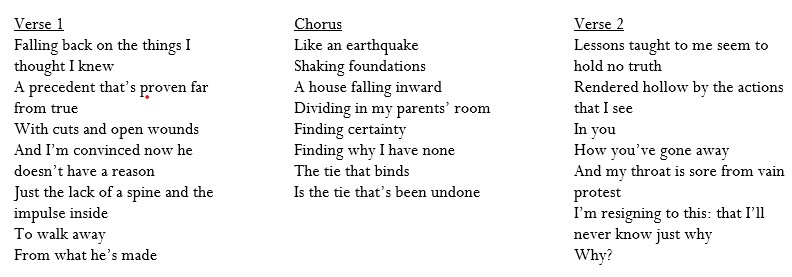
I was nineteen when I wrote those words, only about a year and half removed from their theme, which was the great catastrophe, the really bad thing: the breakup of my parents’ marriage. And though at the time of writing I was still living in the pretty near shadow of that event, in my daily life I dwelt on it only little and spoke of it less. I’d been only months from starting at college when the blow fell and my family split apart, and the prospect of leaving the lonely, awkward house, whose population had so recently been slashed by one-third, to adopt a new place to call home was an opportunity I eagerly embraced.
But in that embrace, I split. The cost of escape from grief and unrelenting pressure was to separate from parts of myself. None of this was in any way apparent to me back then, in my college days. But the clues are there, as I look back. How well I remember, for instance, a feeling that would sometimes settle over me, whenever I was too long in solitude or silence, this sense of essential difference from everyone else in the whole world, of being apart in a way that could never be bridged.
But it’s the lyrics of RTS which bear witness most painfully to the amputation I’d perpetrated against my own soul. The nineteen-year-old who wrote them knew he was angry at his father, he knew he felt betrayed—and that was about all he knew. Or at least, that was all he knew if one takes knew to mean the possession of conscious awareness. But when I listen to the song now, I find already present in my young man’s words the reflection of themes which would derange and threaten to define my life: my vacillation between trust-lessness and my longing for a place where my heart would be safe; my aching to be seen with delight and my hiding from any eyes who might look; my overdeveloped sense of responsibility for the well-being of what remained of my family; my belief that I was—humanly, cosmically—left alone and unprovided for, and the bitterness that bred. I only came to learn these things about the true nature of my way of being—that my life was rooted in a poisoned soil which would make peace and intimacy impossible—by failure, tears, the passage of decades, and near breakdown. How is it, then, that the nineteen-year-old’s lyrics provide some record of what he himself did not perceive? Is it not this, that the rent in his heart went so deep that its flood drew even from its most hidden depths? Glossolalia from a pen, as though tongues of flame had danced above his head as he hunched over his notebook in the back of that lecture hall. I’m pricked with sorrow at the thought, and filled with a mighty compassion.
—
Postscript: Here’s the song. It’s not professional work, and there are moments when most of us who performed on it are in some way off, my vocals included (especially my delivery of the song’s last line, which is not in time). But it’s also a pretty damn good song, even sonically speaking. The drum fill, as the long bridge transitions to the final chorus, is a major standout. The War of Worlds spoken word excerpt was an inspired, delightful addition. And I love how my voice (apparently unintentionally, I have no memory of hamming this up while recording) has some rasp to it, quite fittingly, as I sing, “my throat is sore from vain protest”.
 Ruined or Changed
Leave a comment